The banter channel opened on May 12, right on schedule. That's the tradition. Before a single pawn moves, the trash talk has to flow, and this year it flowed like a heavyweight weigh-in. Boxers staring each other down, except everyone's holding a coffee and worrying about their grade.
Speaking of boxing, Morriston actually has a World Chess Boxing champion in Carl Strugnell. When word got round that he wasn't entering, you could almost hear the collective sigh of relief. One fewer person who can checkmate you and then punch you.
But the real star of the channel was Paul Bevan, our resident anti-hero. Paul spent the lead-up agonising publicly over his 1517 grade, which was apparently hanging by a thread and in mortal danger of being demolished by, in his words, children. He punctuated these laments with a steady stream of demon emojis and whisky shots. The man set the tone. By the time round one came around, the scene was well and truly set.
The Great Pairings Debate
Here's something only chess players would get worked up about: pairing systems.
In the days before round one, Moss floated the idea on the chat that controller Ian Eustis tends to favour Accelerated Swiss pairings. This kicked off a proper debate. Pros, cons, who'd face whom, the lot. By the time Tuesday May 19 came around and we gathered at Castell Nedd club in Cadoxton, people were pacing the room, wondering about last-minute entries and which monster they'd be sat across from once Ian laid out the draw.
Then he did, and it was the regular Swiss way after all. All that speculation for nothing. The gap between the top and bottom halves meant the results were about as surprising as gravity. Top half won across the board. No upsets. Sometimes chess is just maths.
My own round one was against Guto Llewelyn, who played a very good game and made me work for it. That name carries some weight in Welsh chess, because Guto is the nephew of Iolo Jones, and Iolo was always one of the hardest opponents I ever faced.
A Quiet Word for the Welsh Legends
It's worth pausing here, because the chat this year turned, for a while, into something genuinely moving.
People started paying homage to Welsh chess legends. Top of the list were Iolo Jones and his father, T Llew Jones, short for Thomas Llewelyn, though absolutely everyone called him T Llew. Between them they wrote what is, as far as anyone knows, the only chess book ever published in Welsh. It came out in 1980 and was called A Chwaraei Di Wyddbwyll.
Think about that for a second. One book. In Welsh. About chess. In nearly a century of the language being spoken alongside this game in these valleys, that's the whole library.
I have my own small piece of this. As a child I'd talk to T Llew many times at the tournaments down in Gwbert, and he had a way of making a kid feel like his questions about chess actually mattered. Though we didn't only talk chess. He'd sit in the bar and spin stories, and I'd listen, completely caught up in them. A lovely man, and a fascinating one. Years later, facing Iolo across the board was a different experience entirely. He gave very little away and we had several hard fought battles. And now here I was in round one, sat opposite Guto, the next thread in that same family line.
Round Two: Hot Room, Hot Chess
The second round landed at Morriston Rugby Club on May 27, and the temperature was brutal. The room was sweltering. We ended up throwing open the doors to the balcony just to coax some cooler air in, which helped about as much as you'd expect. The chess, mercifully, was hot in a better way.
My third biggest mistake of the tournament happened before a single move was played that night: I didn't wear shorts. Lesson noted for next year.
When the Clocks Betray You
Round three at White Knights on June 3 is the one I'll remember for the wrong reasons.
The clocks weren't set up correctly. Players discovered mid-game, often at the worst possible moment, that they hadn't been receiving their increment. Games ground to a halt. Time got added based on how many moves had been played, all while positions sat there tense and half-finished. It was a mess.
I lost a +6 position in the chaos. I won't pretend I wasn't furious, though mostly at myself for letting it rattle me.
Here's the thing though, and it's why I keep coming back to this game. Chess has this habit of holding up a mirror. The clock problem wasn't really the lesson. The lesson was about how I let an outside thing wreck my focus. That's a flaw I can actually work on, and fixing it won't just help my chess. It'll help everywhere. So yes, I was angry in the moment. Now I'm oddly grateful. A blown position turned into something I can genuinely use. That's one of the quiet beauties of the game.
The Elephant in the Room
Round four, back at Cadoxton on June 9, gave me a front-row seat to an act of pure courage.
George Crockart, sitting right next to me, played the Elephant Gambit. For the uninitiated, this is one of the most dubious openings in all of chess. My personal theory and held by many: almost every opening named after an animal is bad. The Elephant Gambit does little to disprove it.
And yet. George's nerve seemed to pay off. He worked himself into a perfectly playable position, which felt like a small triumph against the chess gods themselves, right up until he blundered later on. Such is life. Such is the Elephant Gambit.
A Lesson in King Safety
The final round arrived with the season's finest example of priorities. Just before play, Emyr-Wyn Francis had to pull out to attend to matters at home, citing, more or less, the avoidance of divorce. A noble withdrawal if ever there was one. Chess will always be there next week. A marriage, generally speaking, does not wait around so patiently. We saluted his tactical retreat and wished him well on the more important board.
For those who did make it to the table, round five brought us Moss McCarthy against Bill Hewitt in an Open Sicilian.
The armchair commentators on the club chat were calling it dead equal. They were wrong. White had a serious advantage. Moss's king was the exposed one, which meant Bill had every reason to keep the queens on and pile on the pressure. Instead he willingly agreed to swap them off, the edge evaporated, and the game drifted into a draw.
For any younger players reading: king safety is one of the big factors in deciding whether to trade queens. When your opponent's king is the unsafe one, keeping queens on the board is your weapon. The surprise here is that Bill knows this better than most. Even the players who understand the rule cold will, every so often, hand the advantage right back. We all have those games.
One Still to Go
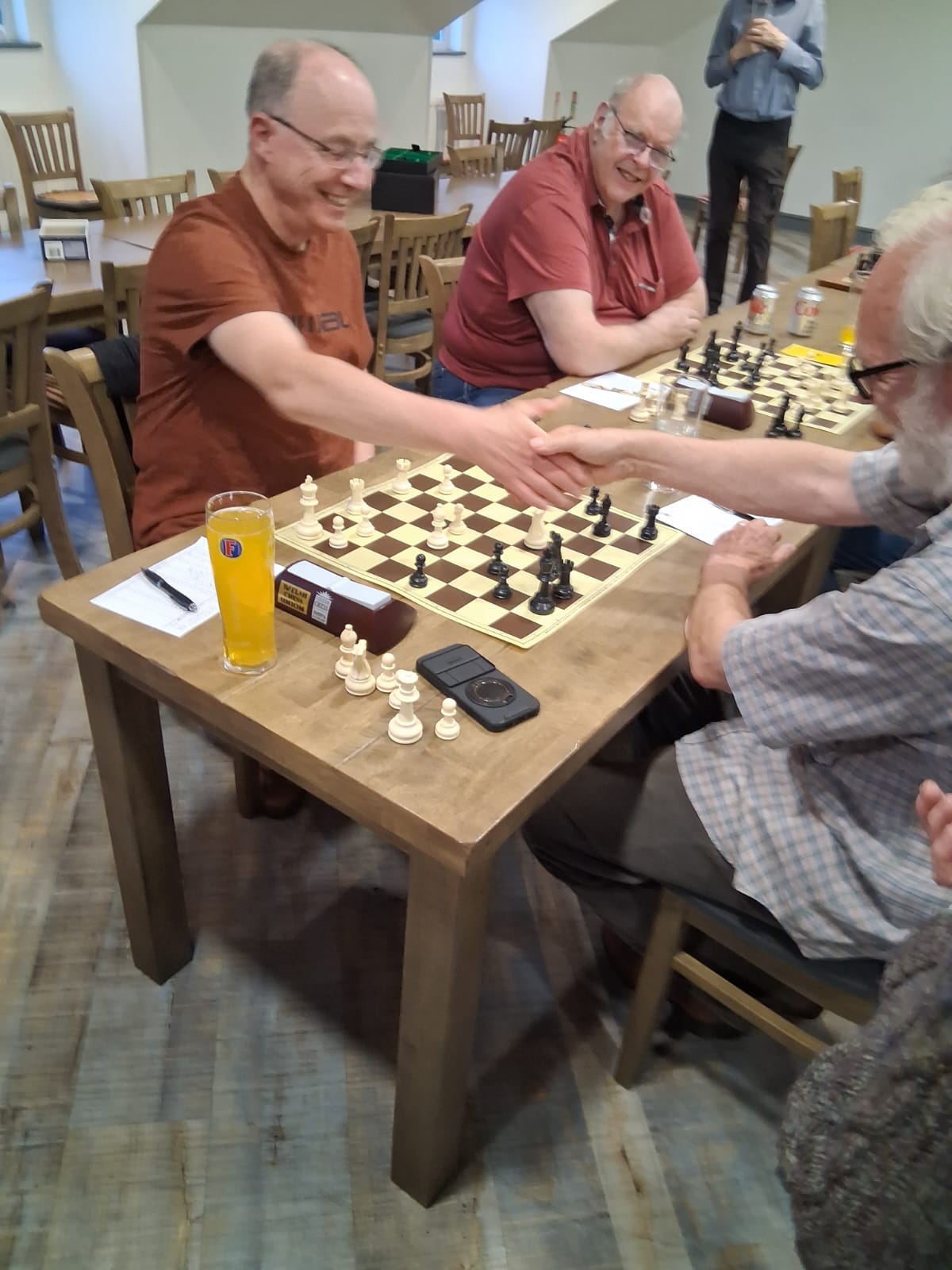
By the time the dust settled, the title was already decided. Bill Hewitt and Moss McCarthy finished joint first on 4.5 out of 5, sharing top spot and the prize between them. So the one game still outstanding, which happens to be mine against Josh, can't shift any of that.
It still matters to Josh, though. If he beats me he's in line for a grading prize, and I'd be doing him a disservice to roll over. No pressure on either of us, then. I wish him a good game, genuinely. If it turns out to be a good one, I'll annotate it here later.
The Poet Laureate of Banter
Some of the games this year were poetry. But Paul Bevan, bless him, inspired poetry of an entirely different sort, which is not something most chess tournaments can claim.
It started with his refusal to lose to children. Then came his ongoing campaign against Ian's old-fashioned, card-based, computer-free way of running the draw. The man wanted a machine. He may live to regret that wish.
So here it is, the ballad his grumbling earned him:
The Ballad of the E J Clarke
Since nineteen-thirty-six it's run, The E J Clarke, our pride, Named for Eddie, long since gone, And ninety years the pieces glide.
Ian Eustis takes the chair, Past eighty, sharp as flint, He coached our youth, he coaches still, His service knows no stint.
Sir Ian? Yes, he'd have his due, A knight for chess, well earned, But staunch republican through and through, He'd see the offer spurned.
He scorns the screen, he shuns the app, He draws the proper way, With cards laid out across his lap, The pairings born today.
His Accelerated Swiss divides The field in quarters four, So strong meets strong and like meets like, A fairer kind of war.
Now Paul, of course, sits Q3 or 4, The greatest 1517, Who's grumbled Ian's pen and card Should yield to the machine.
Be careful, Paul, with what you ask! Those programs, cool and just, Might set some junior to the task Of leaving you in the dust.
For Paul's a speed demon, it's said, His games are quickly through, Then off he strides, full steam ahead, To chat the whole room through.
While others ponder, deep in thought, And silence cloaks the hall, A booming voice, "I should have caught That mate!" and yes, it's Paul.
So twenty-four have joined the fray, The boards are nearly set, Long live the Clarke! Long live the day Ian deals his trusty deck!
What Actually Holds This Thing Together
Strip away the whisky emojis and the demon faces and the running joke about losing to ten-year-olds, and you're left with the part that matters. Twenty-four people showed up, week after week, in hot rugby clubs and rooms with broken clocks, to push wooden pieces around and argue about pairing systems.
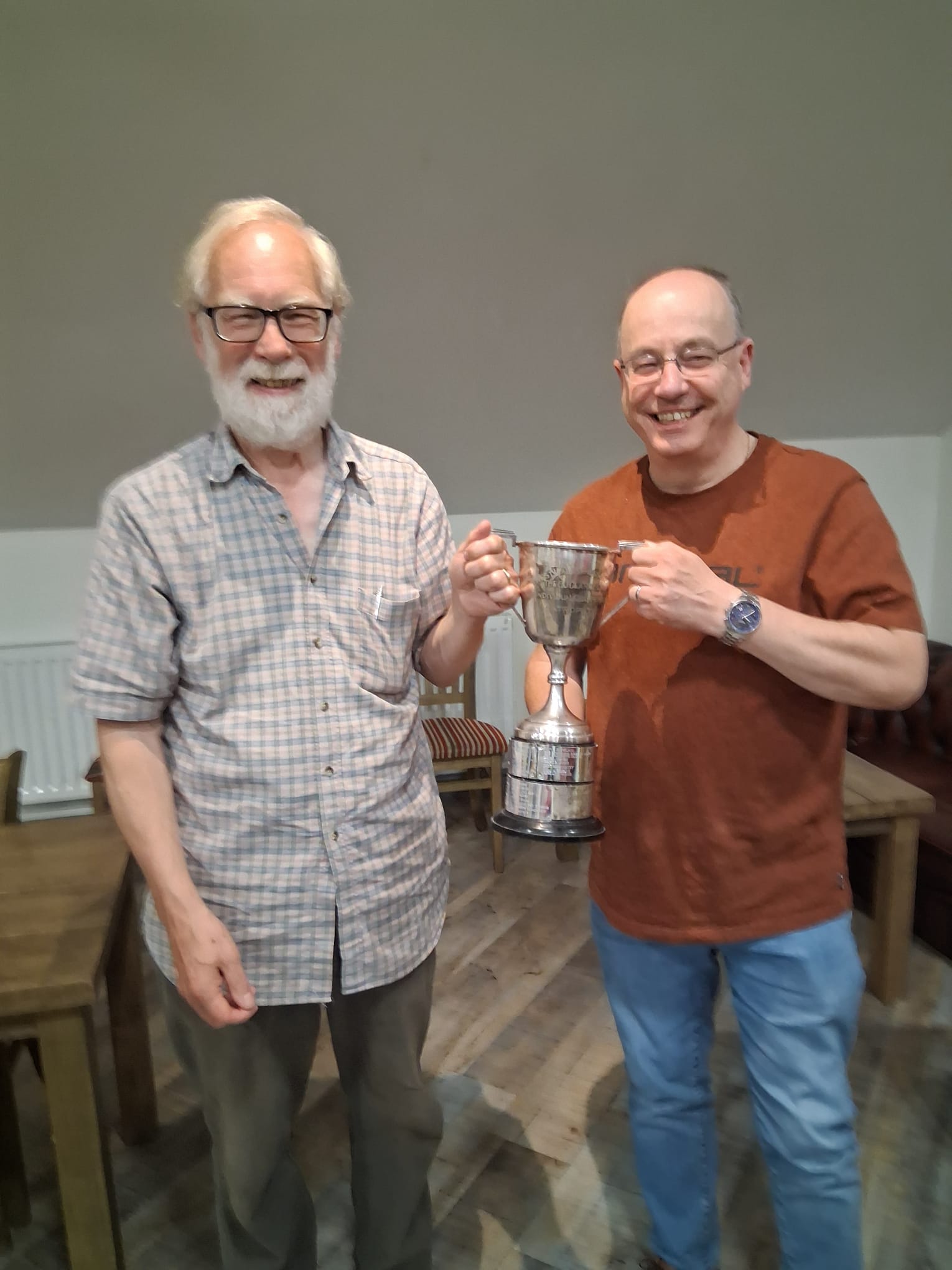
A tournament that's been running since 1936, still steered by a man past eighty who refuses to let a computer near it. That's not nothing. That's a community. And it doesn't run itself. Ian Eustis, with his cards and his pen and his cheerful refusal of the machine age, gave us another tournament to remember, and the whole league owes him a proper thank you for it.
Here's how it finished:
| Place | Player | Score |
|---|---|---|
| 1st= | Bill Hewitt and Moss McCarthy | 4.5 (£70 shared) |
| U1900 | Peter Bevan | 4 |
| U1700 | Carl Halpin (and possibly Josh) | 3.5 |
| U1600 | Tony Goodchild | 3 |
| U1400 | Advik Ram | 3 |
All grading prizes £20.
Congratulations to Bill and Moss on a deserved joint win that both of them thoroughly earned. Two players at the top, sharing the spoils, which feels about right for a tournament where the whole point is the company as much as the chess.
Paul can keep grumbling. The clocks can keep misbehaving. The Elephant Gambit can keep tempting the brave and the foolish. Underneath all of it, everyone here is bound by the same thing: a stubborn, genuine love for this maddening game. That's what made the E J Clarke a success this year, and it's what'll bring everyone back next May, ready to do the weigh-in all over again.
One last thing. If enough players send me their games, I'll put together a second article annotating the best of them. So dig out your scoresheets. The Elephant Gambit deserves a wider audience, if nothing else.
Long live the Clarke.